
Manta Point Komodo Yacht Snorkeling: Season by Month, How Encounters Work & Safety
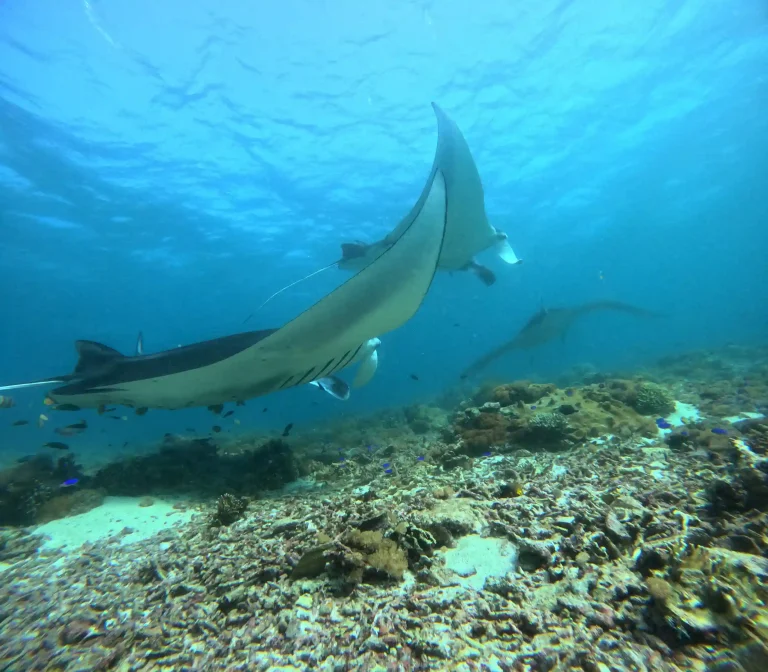
Quick answer: Manta Point Komodo yacht snorkeling is possible year-round because reef manta rays live in the park permanently, but sightings peak from December to March when plankton blooms draw dozens of mantas to the cleaning stations at Karang Makassar. April to November brings calmer seas and clearer water with smaller but still reliable manta numbers. Encounters are drift snorkels from a tender: the crew reads the current, drops you up-current of the mantas, and you float past them — no chasing, no touching, a minimum 3-meter distance.
Where Manta Point Is and Why Mantas Gather There
Manta Point — locally called Karang Makassar — is a long, shallow rubble ridge in the central strait of Komodo National Park, roughly 45–60 minutes by yacht from Labuan Bajo depending on sea state. It is not a pretty coral garden; the bottom is mostly broken rubble at 5–12 meters. What makes it world-famous is function, not beauty: the ridge sits in a nutrient highway where tidal currents funnel plankton, and it hosts cleaning stations where small wrasses pick parasites off manta rays. Mantas come here to feed and to be cleaned, which means they are relaxed, slow-moving, and predictable — ideal conditions for snorkelers.
The rays you will meet are reef mantas (Mobula alfredi), typically 3 to 4.5 meters across. Komodo’s population is resident, one of the reasons the park delivers among the most consistent manta snorkeling anywhere in Indonesia.
Manta Season by Month: The Honest Version
Plenty of marketing claims “mantas guaranteed all year.” The truth is more nuanced, and worth knowing before you lock dates.
| Months | Manta Activity | Sea & Visibility | Verdict |
|---|---|---|---|
| December – March | Peak. Plankton-rich water can bring 10–30+ mantas to the ridge, including feeding chains and courtship trains. | Wet season: occasional rain squalls, choppier crossings, visibility often 10–15 m (greener water — that green is the food). | Best for sheer manta numbers; accept some weather trade-off. |
| April – June | Very good. Numbers ease off peak but sightings remain frequent, often 3–10 mantas per drift. | Seas settle, visibility improves to 15–25 m, hills still green. | Arguably the best overall balance for a yacht trip. |
| July – September | Reliable but variable. Cooler, current-rich water; some days deliver big groups, others 1–3 individuals. | Dry-season prime: calm anchorages, 20 m+ visibility, strongest trade-wind afternoons. | Peak sailing conditions; mantas likely but not at December density. |
| October – November | Building again as plankton returns. | Glassy seas, warm water, excellent visibility. | Underrated shoulder window with fewer boats at the site. |
Two honest caveats. First, mantas are wild animals: even in peak months a specific 30-minute window can be empty, which is why itineraries in the park schedule Manta Point across more than one opportunity when tides allow. Second, the overall cruising season matters as much as manta statistics — the dry season from April to November gives you the calmest crossings, the most comfortable nights at anchor, and the best conditions for the rest of the itinerary (Padar sunrise, Pink Beach, the dragon trekking at Komodo or Rinca).
How a Yacht-Based Manta Encounter Actually Works
Snorkeling Manta Point from a private yacht is a different experience from arriving on a crowded day speedboat, and the mechanics matter.
- Timing the tide. Your captain aims for moderate current — enough to concentrate plankton and keep mantas at the cleaning stations, not so much that snorkelers get swept off the site. Yachts that overnight inside the park can wait for the right window instead of racing a fixed day-trip schedule.
- Spotting from the bow. Crew scan for wingtips and dark shadows over the pale rubble. Mantas at Karang Makassar often sit near the surface, so they are visible from deck before you ever get wet.
- The drift drop. You board the tender, motor up-current of the animals, and slip in quietly — no jumping, no splash. The current then carries you over the cleaning station while the tender shadows the group downstream.
- The pass. Stay horizontal on the surface, keep fins slow and shallow, and let the manta control the encounter. Relaxed mantas frequently loop back and pass within a few meters of calm snorkelers. Chasing ends the encounter for everyone.
- Repeat. The tender picks you up at the end of the drift and can run two or three more passes while conditions hold — the single biggest advantage over one-shot day boats.
Safety at Manta Point: What Good Operators Enforce
- Current briefing before every drop. Karang Makassar’s current can shift mid-session. You should hear a clear plan: entry point, drift line, pickup point, and the recall signal.
- Tender always in the water. A dedicated dinghy tracks the snorkel group for the entire session — non-negotiable at a current site.
- Guide in the water with you. A dive-trained guide leads the drift, watches weaker swimmers, and positions the group correctly relative to the mantas.
- Manta code of conduct. Minimum 3 m distance, no touching, no blocking a manta’s path over the cleaning station, no duck-diving on top of animals, no flash photography.
- Fitness honesty. Confident swimmers only in strong current; on gentler tides, guides can support beginners with flotation aids. Life jackets and fitted fins should be provided as standard.
- Park compliance. Every guest pays the Komodo National Park entrance fee of IDR 650,000 per person, handled with your rangers and permits — a legitimate operator itemizes this transparently.
Fitting Manta Point Into a Komodo Yacht Itinerary
Manta Point sits conveniently between Padar Island and Komodo Island, so nearly every route passes it. On our 3-day Komodo yacht itinerary with Manta Point snorkeling, the site is typically slotted for mid-morning of day two, after Padar sunrise, when light is good and tides are most workable — with a backup slot on day three if the first session underdelivers. That two-chance structure is the practical reason a liveaboard trip out-performs a day trip for manta encounters.
Travelers on a budget can join the best-selling 3D2N share trip — chosen by roughly 91% of guests — via the Komodo open trip sailing packages, while couples and families who want the site to themselves at first light can charter privately, up to the flagship level of the ultra-luxury Komodo Signature yacht. Pricing is in USD, with a 50% deposit to confirm and the balance due 14 days before departure.
FAQ
What are the chances of seeing mantas at Manta Point?
High, but never 100%. Across the year, multi-day yacht trips that visit the site at the right tide report manta sightings on the large majority of visits, with December–March the statistical peak and single quiet days most likely in the mid-dry-season months. Booking an itinerary with two scheduled attempts is the most effective way to protect your odds.
Can non-swimmers or kids snorkel with the mantas?
Often yes, with conditions. On gentle tides, guides take children and weak swimmers out with life jackets and one-on-one support, and mantas near the surface are visible even from the tender. In strong current the guide will restrict the water session to confident swimmers — a call you should want your crew to make conservatively.
Keep reading
More from the journal

Sailing & Charters
Komodo Yacht Tours for Seniors: An Honest Accessibility Guide (Padar, Dragons, Boarding)
Yes, seniors and guests with limited mobility can absolutely enjoy a Komodo yacht tour — if the trip is designed…
Sailing & Charters
Do You Need Diving Certification for Komodo? Requirements Explained
No, you do not need a diving certification to visit Komodo — snorkelers can enjoy Manta Point, Pink Beach, and…
Sailing & Charters
Komodo Open Trip Share Cabin Price 2027: Full Per-Person Breakdown
The Komodo open trip share cabin price for 2027 starts from USD 390 per person for a 3-day 2-night (3D2N)…